Ownership
Is a Land Rover Defender a Good Daily Driver? An Honest Answer
Some of the links on this page go to Amazon. If you buy through one, we get a small cut and you pay exactly the same. It costs you nothing, it pays for the hosting, and we only link to things we would actually use ourselves.
Somewhere right now a person is sitting in an office, staring out of the window at a grey car park, and thinking: I could just buy a Defender and drive that every day.
They are picturing a frosty morning, a flask, a dog in the back and a lane with no traffic on it. What they are not picturing is the M6 in February, a four hour meeting they are already late for, and a heater producing roughly the same warmth as a disappointed look.
So: can you daily a Defender? Yes. Should you? That depends entirely on which one, and on whether you have been honest with yourself about your actual life rather than the life in the photograph.
The short version
| Your commute | Classic Defender | New Defender |
|---|---|---|
| Short, rural, mostly lanes | Excellent | Excellent, and overkill |
| Long motorway runs | Punishing | Excellent |
| City, multi storey car parks | Grim | Grim, for different reasons |
| School run, kids, car seats | Awkward | Easy |
| Carrying dogs, tools, mud | Perfect | Perfect but you will worry |
| You have no second car | Think very hard | Fine |
The classic Defender as a daily: what nobody tells you
None of this is a reason not to. All of it is a reason to find out before rather than after.
- The noise. This is the one that defeats people. At motorway speed a classic Defender is loud enough that conversation becomes shouting and a phone call is not realistically happening. Sound deadening helps a great deal and does not fix it.
- The seating position. The pedals are offset, the wheel is close and flat, and the door is somewhere near your right shoulder. Some people find it fine for ever. Some people’s backs and knees have strong opinions after an hour. Drive one for a proper distance, not around the block.
- The heater. In a classic, the heater is more of a gesture than a system. It works, slowly, eventually, and the windscreen demist is a long term project rather than an event. Leave more time in winter than you think, and accept that a heated seat cushion is the cheapest fix anybody has found for it.
- The economy. Nobody buys one for this. A 300Tdi or a Td5 in normal use lands somewhere in the twenties to low thirties per gallon, and a V8 is a different conversation entirely. Our fuel economy article has the figures by engine.
- Safety. This matters and gets skipped. A classic Defender has no crumple zones in the modern sense, no airbags on most, and a body on chassis design from another era. It is a very reassuring thing to drive and that is not the same as being safe in a crash.
- Security. Parking one somewhere unattended every day is a genuine consideration, because Defenders are stolen constantly. Worth reading what actually works before, not after.
- It will need you. Not catastrophically, but regularly. There is a reason a jump pack lives in the door pocket of so many of them. Something will weep, something will squeak, something will need attention most months. If a vehicle needing attention makes you anxious rather than interested, this is not the vehicle.

it may as well be recognisable. Eighty millimetres, weatherproof, sticks to anything.
And what it gives back
All of the above is true and people still do it for decades, which should tell you something.
- You can put anything in it. Wet dog, bags of sand, a bicycle without taking the wheel off, a Christmas tree. No anxiety, no boot liner diplomacy, hose it out afterwards.
- Nothing stops it. Snow, floods, a field, a building site. The day everybody else is working from home because of the weather, you are the one who gets through.
- It is fixable. Simple, documented, and supported by a parts industry that will outlive all of us. A fifteen year old German SUV with a failed module is scrap. A thirty year old Defender is a Saturday.
- It does not lose money the way a normal car does. Bought sensibly, maintained properly, it is one of very few vehicles you can use daily for years and sell for something close to what you paid.
- The speed. It is slow, and being forced to be slow turns out to be unexpectedly good for a person. You stop overtaking. You arrive in a better mood than people who went faster.
The new Defender as a daily: a genuinely different animal
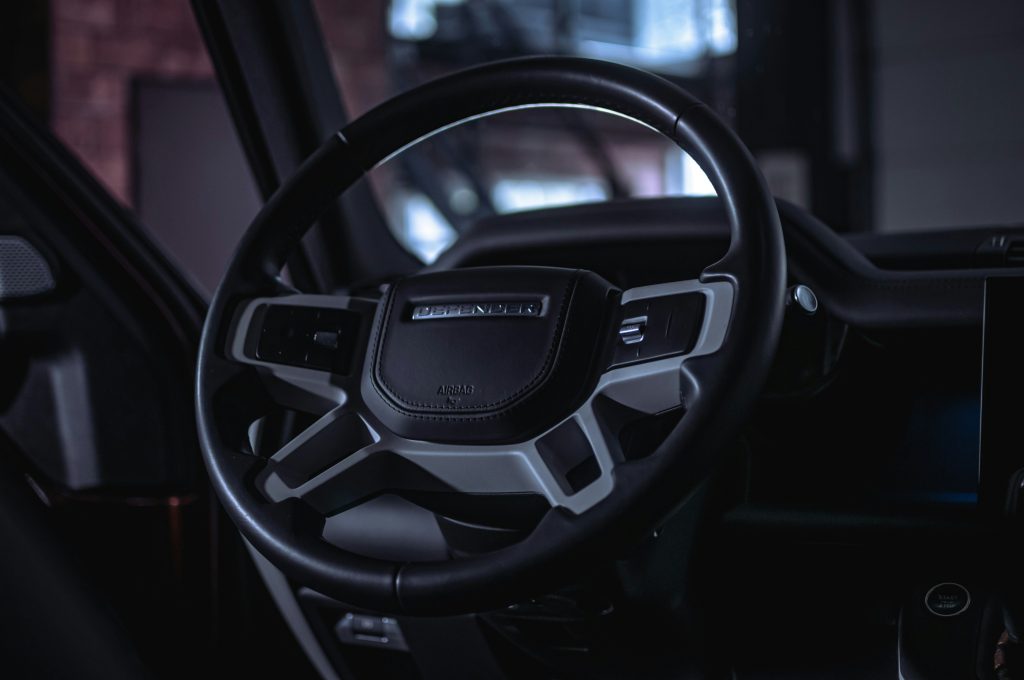
The new one is a comfortable, quiet, quick, modern car that happens to be properly capable off road. Daily driving it is not a compromise and barely needs discussing. So the honest points are the ones people only discover after a month.
- Size. It is wide. Multi storey car parks, narrow lanes with stone walls, and your own garage door all become live issues. Measure the garage before, not after.
- Running costs. This is a large, heavy, premium vehicle. Tyres, brakes, servicing and insurance are priced accordingly, and the bills do not feel like Defender bills.
- Theft. Among the most targeted vehicles there are, and insurers know it. Factor the premium and the security in from the start.
- The worry. People buy one to use it properly and then discover they flinch at a hedge. If you are going to be precious about it, the classic genuinely is the more relaxing daily.
- The 90 is smaller than it looks. Lovely vehicle, three doors, and the rear seats and boot are a real compromise with a family. Worth reading 90 against 110 before committing.
Before you commit, do these four things
- Drive one for an hour, not ten minutes. On a motorway. With the heater on and the radio at a volume you would normally use. Everything you need to know arrives in the second half hour.
- Measure the car park and the garage. Both Defenders are taller than people expect and the new one is wider.
- Get an insurance quote first. Not after you have agreed to buy. The numbers surprise people in both directions, and our insurance article explains why.
- Be honest about the second car. A classic Defender as the only vehicle for a household with jobs and children is a bold position. As the second one it is close to perfect.
So which one, if you are actually doing this?
If your driving is mostly short, mostly rural, and you enjoy machinery, the classic is one of the great daily drivers and the ownership is half the pleasure. If you do long motorway miles, carry children, or have no appetite for a vehicle that asks things of you, the new one is simply a better car, and there is no shame whatsoever in that.
And if your real plan is a Defender for weekends and something dull for Tuesdays, that is not a cop out. That is what most of the people with the nicest Defenders are quietly doing.
Daily driving a Defender: common questions
Can you daily drive a classic Land Rover Defender?
Yes, and many people do for decades. The real obstacles are motorway noise, a weak heater, the offset driving position and modern safety expectations. If your journeys are short and mostly rural, none of it matters much.
Is a Defender comfortable on long motorway journeys?
A classic is not. It is loud enough to make conversation difficult and the seating position tires some people within an hour. The new Defender is genuinely comfortable over distance and is a different vehicle in this respect.
What fuel economy will I get daily driving a Defender?
A classic diesel in everyday use generally sits in the twenties to low thirties per gallon depending on engine, gearing, tyres and how boxy the load is. Petrol V8s are considerably thirstier. Expect worse than the brochure in winter and on short trips.
Is a Defender safe enough for a family car?
A new Defender is a modern car with modern safety systems. A classic has no crumple zones in the modern sense and most have no airbags, so it is a different proposition and worth thinking about honestly if it is carrying children every day.
Is a Defender expensive to run every day?
A classic is cheap to fix and thirsty to feed, and the bills are frequent but usually small. A new one is the opposite: few bills, each of them substantial. Neither is cheap, they are expensive in different rhythms.
Should I buy a 90 or a 110 for daily use?
A 110 for almost anybody carrying people or things regularly. The 90 is shorter, easier to park and more fun, and the rear seats and boot are a genuine compromise with a family.
While you are here
- Classic against new, in full.
- 90 against 110, before you pick a shape.
- The buying guide, for what to check.
- Running costs, with the numbers.
- The winter guide, which is when daily driving one gets interesting.
And once it is yours and parked somewhere good, it belongs on the map.
Read more
Land Rover Defender Maintenance Schedule and Costs
If you have ever wondered what owning a Land Rover Defender actually costs in terms of ongoing maintenance,...
Jun 8, 2026What It Really Costs to Restore a Land Rover Defender
Some of the links on this page go to Amazon. If you buy through one, we get a...
Nov 2, 2026Land Rover Defender Common Problems (& How to Fix Them)
There's a saying among Defender owners that goes something like this: "If it's not leaking oil, it's out...
Jun 1, 2026Shop
Wear the sighting.
Small things for people who slow down when a Defender comes the other way. Printed in Estonia, posted anywhere in the world.